New York City Ballet John F Kennedy Center for the Performing Arts 27 De Marzo
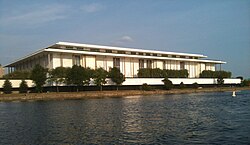 Kennedy Center seen from the Potomac River | |
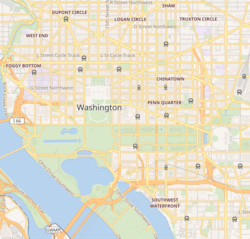
| John F. Kennedy Memorial Eye for the Performing Arts Location inside Central Washington, D.C. Show map of Central Washington, D.C. John F. Kennedy Memorial Center for the Performing Arts John F. Kennedy Memorial Center for the Performing Arts (the United States) Show map of the United States | |
| Address | 2700 F Street, NW |
|---|---|
| Location | Washington, D.C., Us |
| Coordinates | 38°53′45″N 77°03′21″W / 38.8957°N 77.0559°W / 38.8957; -77.0559 Coordinates: 38°53′45″N 77°03′21″W / 38.8957°Northward 77.0559°Due west / 38.8957; -77.0559 |
| Public transit |  Washington Metro Washington Metro    at Foggy Lesser–GWU station at Foggy Lesser–GWU station Metrobus Metrobus |
| Owner | United states of america government |
| Operator | John F. Kennedy Center for the Performing Arts David Rubenstein, Chairman Deborah Rutter, President |
| Blazon | Performing arts centre |
| Capacity | Concert Hall: ii,454 Opera Business firm: 2,294 Eisenhower Theater: 1,161 Terrace Theater: 475 Theater Lab: 398 Family Theater: 320 Jazz Club: 160 |
| Construction | |
| Bankrupt ground | December 2, 1964 |
| Opened | September 8, 1971 (1971-09-08) |
| Architect | Edward Durell Stone |
| Structural engineer | Severud Associates |
| General contractor | John McShain |
| Tenants | |
| National Symphony Orchestra Washington National Opera | |
| Website | |
| www | |


Bosom of John F. Kennedy by Robert Berks located opposite the entrance to the Opera House in the Eye
The John F. Kennedy Middle for the Performing Arts (formally known as the John F. Kennedy Memorial Center for the Performing Arts, and commonly referred to equally the Kennedy Heart) is the United States National Cultural Heart, located on the Potomac River in Washington, D.C. Information technology was named in 1964 every bit a memorial to assassinated President John F. Kennedy. Opened on September viii, 1971, the center hosts many unlike genres of functioning fine art, such equally theater, dance, orchestras, jazz, pop, and folk music.
Authorized by the 1958 National Cultural Middle Act of Congress,[1] which requires that its programming be sustained through individual funds, the heart represents a public–private partnership. Its activities include educational and outreach initiatives, most entirely funded through ticket sales and gifts from individuals, corporations, and private foundations.
The original building, designed by architect Edward Durell Stone,[1] was constructed by Philadelphia contractor John McShain, and is administered every bit a bureau of the Smithsonian Institution. An earlier design proposal called for a more curvy, spaceship-inspired edifice like to how the Watergate complex appears today.[two] An extension to the Durell Stone Building was designed by Steven Holl and opened in 2019. The center receives annual federal funding to pay for building maintenance and operation.
History [edit]
The idea for a national cultural center dates to 1933 when First Lady Eleanor Roosevelt discussed ideas for the Emergency Relief and Ceremonious Works Administration to create employment for unemployed actors during the Great Depression.[3] Congress held hearings in 1935 on plans to found a Chiffonier level Department of Science, Art and Literature, and to build a awe-inspiring theater and arts building on Capitol Hill nigh the Supreme Courtroom building. A 1938 congressional resolution called for construction of a "public building which shall be known as the National Cultural Heart" near Judiciary Square, but nothing materialized.[iii]

Flags in the Hall of States
The idea for a national theater resurfaced in 1950, when U.S. Representative Arthur George Klein of New York introduced a neb to authorize funds to plan and build a cultural centre. The beak included provisions that the heart would prohibit any discrimination of cast or audition. In 1955, the Stanford Research Institute was deputed to select a site and provide pattern suggestions for the center.[4] From 1955 to 1958, Congress debated the idea amid much controversy. A neb was finally passed in Congress in the summertime of 1958 and on September four, President Dwight D. Eisenhower signed into law the National Cultural Centre Act which provided momentum for the project.[v]
This was the first fourth dimension that the federal regime helped finance a construction dedicated to the performing arts. The legislation required a portion of the costs, estimated at $10–25 million, to be raised inside 5 years of the bill's passage.[vi] Edward Durell Stone was selected as architect for the project in June 1959.[7] He presented preliminary designs to the President'due south Music Committee in October 1959, along with estimated costs of $50 million, double the original estimates of $25–30 million. By November 1959, estimated costs had escalated to $61 one thousand thousand.[8] Despite this, Stone'south design was well received in editorials in The Washington Post, Washington Star, and chop-chop approved by the United states Commission of Fine Arts, National Capital Planning Commission, and the National Park Service.[9]
The National Cultural Center was renamed the John F. Kennedy Center for the Performing Arts in 1964, post-obit the assassination of President Kennedy.[x]
Fundraising [edit]
The National Cultural Centre Board of Trustees, a group President Eisenhower established January 29, 1959, led fundraising.[vi] Fundraising efforts were not successful, with only $13,425 raised in the beginning three years.[11] President John F. Kennedy was interested in bringing civilisation to the nation'due south capital, and provided leadership and back up for the project.[12] In 1961, President Kennedy asked Roger Fifty. Stevens to assist develop the National Cultural Center, and serve every bit chairman of the Board of Trustees. Stevens recruited First Lady Jacqueline Kennedy as Honorary Chairman of the Center, and former Offset Lady Mamie Eisenhower every bit co-chairman.[xiii] In Jan 1961, Jarold A. Kieffer became the first Executive Director of the National Cultural Center, overseeing numerous fundraising efforts and assisting with the architectural plan.[xiv]
The total cost of construction was $seventy million.[10] Congress allocated $43 million for construction costs, including $23 million as an outright grant and the other $20 million in bonds.[12] Donations also comprised a pregnant portion of funding, including $v million from the Ford Foundation, and approximately $500,000 from the Kennedy family unit.[xv] [xvi] Other major donors included J. Willard Marriott, Marjorie Merriweather Post, John D. Rockefeller III, and Robert W. Woodruff, likewise every bit many corporate donors.[16] Strange countries provided gifts to the Kennedy Centre, including a gift of 3,700 tons of Carrara marble from Italy (worth $1.five 1000000) from the Italian government, which was used in the building's construction.[17]
Structure [edit]
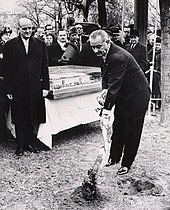
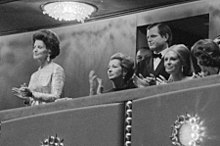
President Lyndon B. Johnson dug the formalism first-shovel of earth at the groundbreaking for the Kennedy Eye December 2, 1964.[eighteen] Still, debate continued for another year over the Foggy Bottom site, with some advocating for some other location on Pennsylvania Avenue.[15] Earthworks of the site got underway on Dec 11, 1965, and the site was cleared by Jan 1967.[nineteen]
The first operation was September 5, 1971, with 2,200 members of the general public in attendance to encounter a premiere of Leonard Bernstein's Mass in the Opera House,[x] while the Center's official opening took place September eight, 1971, with a formal gala and premiere performance of the Bernstein Mass.[20] The Concert Hall was inaugurated September 9, 1971, with a performance by the National Symphony Orchestra conducted by Antal Doráti.[20] Alberto Ginastera'south opera, Beatrix Cenci premiered at the Kennedy Center Opera House September x, 1971. The Eisenhower Theater was inaugurated October eighteen, 1971, with a performance of A Doll's Business firm starring Claire Bloom.[21]
Compages [edit]
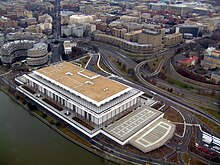
Architect Edward Durell Stone designed the Kennedy Center.[22] Overall, the edifice is 100 anxiety (30 one thousand) high, 630 feet (190 m) long, and 300 feet (91 k) wide. The Kennedy Center features a 630-human foot-long (190 k), 63-human foot-high (19 1000) grand entrance hall, with 16 hand-blown Orrefors crystal chandeliers (a gift from Sweden) and blood-red carpeting. The Hall of States and the Hall of Nations are both 250-foot-long (76 m), 63-foot-loftier (19 m) corridors. The edifice has fatigued criticism about its location (far away from Washington Metro stops), and for its calibration and form,[22] although it has as well drawn praise for its acoustics, and its terrace overlooking the Potomac River.[22] In her book On Architecture, Ada Louise Huxtable called it "gemütlich Speer."[23]
Cyril M. Harris designed the Kennedy Middle's auditoriums and their acoustics.[24] A key consideration is that many aircraft fly along the Potomac River and overhead the Kennedy Middle, as they take off and land at the nearby Ronald Reagan Washington National Aerodrome. Helicopter traffic over the Kennedy Centre is also fairly high. To go on out this noise, the Kennedy Heart was designed as a box within a box, giving each auditorium an actress outer trounce.[25]
After the original structure was marked for expansion, a competition in 2013 selected Steven Holl Architects to undertake the pattern.[26] The extension, chosen The REACH, opened in 2019.[27]
Artwork [edit]
The plaza entrance of the Kennedy Center features 2 tableaus by High german sculptor Jürgen Weber; created between 1965 and 1971, which were a gift to the Kennedy Center from the W German language government. Near the due north stop of the plaza is a display of nude figures in scenes representing war and peace, called War or Peace. The slice, eight ft × 50 ft × i.5 ft (2.44 m × xv.24 chiliad × 0.46 g), depicts five scenes showing the symbolism of war and peace: a war scene, murder, family, and creativity.[28] At the due south cease is America which represents Weber's image of America (viii × 50 × 1.5 ft.). Iv scenes are depicted representing threats to liberty, technology, foreign help and survival, and gratuitous oral communication.[29] Information technology took the creative person four years to sculpt the two reliefs in plaster, creating 200 castings, and some other two years for the foundry in Berlin to cast the pieces. In 1994, the Smithsonian Institution'southward Relieve Outdoor Sculpture! programme surveyed War or Peace and America and described them every bit being well maintained.[28] [29] Another sculpture Don Quixote by Aurelio Teno occupies a site nearly the northeast corner of the building. King Juan Carlos I and Queen Sofia of Spain gave the sculpture to the United States for its Bicentennial, June three, 1976.[30]
Venues [edit]
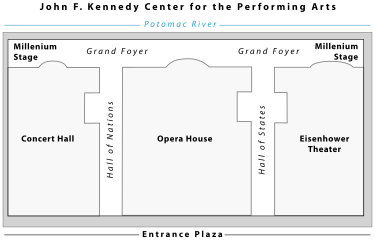
Layout of the three main theaters at the Kennedy Centre
The Kennedy Heart has three primary theaters: the Concert Hall, the Opera House, and the Eisenhower Theater.
Concert Hall [edit]
The Concert Hall, located at the southward end of the Center, seats 2,442 including chorister seats and stage boxes, and has a seating arrangement similar to that used in many European halls such as Musikverein in Vienna. The Concert Hall is the largest performance space in the Kennedy Center and is the home of the National Symphony Orchestra. A 1997 renovation brought a high-tech acoustical canopy, handicap-accessible locations on every level, and new seating sections (onstage boxes, chorister seats, and parterre seats). The Hadeland crystal chandeliers, given by the Norwegian Crown, were repositioned to provide a clearer view.[17] Canadian organbuilder Casavant Frères constructed and installed a new piping organ in 2012.[31]
Opera House [edit]
The Opera House, in the center, has nigh 2,300 seats. Its interior features include walls covered in red velvet, a distinctive ruddy and golden silk mantle, given past the Japanese government, and Lobmeyr crystal chandelier with matching pendants, which were a gift from the government of Austria.[17] It is the major opera, ballet, and big-scale musical venue of the Center, and airtight during the 2003/2004 season for all-encompassing renovations which provided a revised seating arrangement and redesigned entrances at the orchestra level. It is the home of the Washington National Opera and the annual Kennedy Middle Honors.
Eisenhower Theater [edit]
The Eisenhower Theater, on the north side, seats about one,163 and is named for President Dwight D. Eisenhower, who signed the National Cultural Center Act into police force on September two, 1958. It primarily hosts plays and musicals, smaller-scale operas, ballet and contemporary dance. The theater contains an orchestra pit for up to 35 musicians that is convertible to a forestage or boosted seating infinite. The venue reopened in October 2008, following a 16-month renovation which altered the colour scheme and seating arrangements.
Other performance venues [edit]
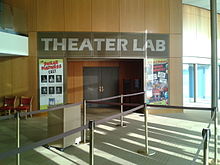
Entrance to the Theater Lab
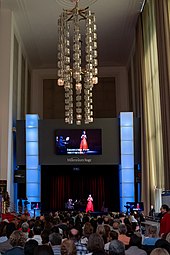
The Millennium Stage in 2019
Other functioning venues in the Middle include:
- The Family Theater, with 324 seats, opened December 9, 2005. Information technology replaced the quondam American Film Institute Theater located adjacent to the Hall of States. Designed by the architectural firm Richter Cornbrooks Gribble, Inc. of Baltimore, the new theater incorporates a computerized rigging system; and a digital video project system.
- The Terrace Theater, with 513 seats, was constructed on the roof terrace level in the late 1970s equally a Bicentennial gift from the people of Japan to the United States. It is used for sleeping accommodation music, ballet and contemporary trip the light fantastic toe, and theater.
- The Theater Lab, with 399 seats, currently houses the whodunit Shear Madness which has been playing continuously since August 1987.
- The Millennium Stage. Function of the concept of "Performing Arts for Everyone" launched by Chairman James Johnson in the wintertime of 1997, the Millennium Stage provides gratuitous performances every evening at half-dozen:00 pm on two specially created stages at either cease of the Grand Foyer. A broad range of art forms are featured on the Millennium Phase. These include performing artists and groups from all l states and an Artist-in-Residence plan featuring artists performing several evenings in a month. Every show on the Millennium Phase is available as a simulcast of the alive show at half dozen:00 pm, and is archived for later viewing via the Kennedy Center's website.
- The Terrace Gallery. On March 12, 2003, the infinite formerly known equally the Education Resource Center was officially designated the Terrace Gallery. It is now dwelling house to the Kennedy Center Jazz Club.
River and rooftop terraces [edit]
The Kennedy Center offers i of the few open-air rooftop terraces in Washington, D.C.; information technology is complimentary of charge to the public from 10:00 a.thousand. until midnight each twenty-four hour period, except when airtight for private events. The wide terrace provides views in all four directions overlooking the Rosslyn skyline in Arlington, Virginia, to the West; the Potomac River and National Airport to the South; the Washington Harbor and the Watergate Complex to the North; and the Lincoln Memorial, Department of Country buildings, George Washington University and the Saudi Embassy to the East.

The Grand Entrance hall, at 63 feet (19 one thousand) loftier and 630 feet (190 1000) long, is one of the largest rooms in the earth. If laid on its side, the Washington Monument would fit in this room with 75 feet (23 grand) to spare.
Productions [edit]
Dance [edit]
World premiere performances of Kennedy Center-deputed works have been offered through a commissioning programme for new ballet and dance works. These works have been created past America's foremost choreographers—Paul Taylor, Lar Lubovitch, and Merce Cunningham—for leading American dance companies including American Ballet Theatre, Ballet West, Houston Ballet, Pacific Northwest Ballet, Pennsylvania Ballet, and the San Francisco Ballet. The Kennedy Heart formerly supported and produced the Suzanne Farrell Ballet in performances at the Center and on extended tours.
The Center sponsors two annual dance residency programs for young people; Exploring Ballet with Suzanne Farrell and the Trip the light fantastic Theatre of Harlem Residency Programme, both now in their 2d decade. The Kennedy Middle'southward Contemporary Dance series offers a wide range of artistic perspectives, from the foremost masters of the genre to the art form's newest and about exciting artists. In the 2008/2009 serial, the Kennedy Center recognized Mod Masters of American Dance, bringing Martha Graham Dance Company, Merce Cunningham Dance Company, Limón Dance Visitor, Mark Morris Dance Group, Alvin Ailey American Trip the light fantastic toe Theater, Bill T. Jones/Arnie Zane Dance Company and Paul Taylor Dance Company.
Education [edit]
In recent years the Kennedy Center has dramatically expanded its educational activity programs to reach immature people, teachers, and families throughout the nation. The 2005 opening of the Family Theater has helped achieve this.
Performances for Immature Audiences [edit]
- Theater for Young Audiences (TYA)
The 2008–2009 season programming for Performances for Young Audiences reached more than 100 performances for young people and their families and over 110 performances for schoolhouse audiences. The season included four Kennedy Center-deputed world premieres: The Trumpet of the Swan, a musical adapted by Pulitzer Prize winner Marsha Norman from the book by E.B. White with music by Jason Robert Brown; Mermaids, Monsters, and the Earth Painted Royal, a new play by Marco Ramirez; Unleashed! The Hush-hush Lives of White Firm Pets, a new play by Allyson Currin in collaboration with the White Firm Historical Association; and OMAN...O human being!, a new dance production conceived and directed by Debbie Allen and is part of the Eye'due south Arab festival, Arabesque: Arts of the Arab World. Theater for Young Audiences on Bout toured with two nationally touring productions of The Phantom Tollbooth and Blues Journeying.
On June 8, 2016 it was announced that the Kennedy Eye Theater for Young Audiences-commissioned musical Elephant & Piggie's Nosotros are in a Play!, with volume and lyrics by Mo Willems and music by Deborah Wicks La Puma, will transfer to the Off-Broadway New Victory Theater in Jan 2017.[32]
- National Symphony Orchestra Performances for Young Audiences
Members of the National Symphony Orchestra will go along to present Teddy Acquit Concerts throughout its seasons. During these concerts, children aged three to five bring their favorite blimp animal to interactive musical programs featuring members of the NSO. Members of the NSO present NSO Ensemble Concerts, connecting music with various school subjects such as science and math, Kinderkonzerts, introducing kids to orchestral instruments and classical composers, equally well equally NSO Family unit Concerts.
Kennedy Center American College Theater Festival (KCACTF) [edit]
Started in 1969 by Roger L. Stevens, the Kennedy Middle'due south founding chairman, the Kennedy Heart American College Theater Festival (KCACTF) is a national theater program involving eighteen,000 students from colleges and universities nationwide which has served as a catalyst in improving the quality of college theater in the United States. The KCACTF has grown into a network of more 600 academic institutions throughout the country, where theater departments and student artists showcase their work and receive exterior assessment past KCACTF respondents. Since its establishment in 1969, KCACTF has reached more than 17.5 million theatergoing students and teachers nationwide.
Changing Instruction Through the Arts (CETA) [edit]
The Kennedy Center'southward CETA program'south mission is make the arts a disquisitional component in every child's teaching. CETA, which stands for Changing Education Through the Arts, creates professional development opportunities for teachers and school administrators. Each year over 700 teachers participate in approximately lx courses that focus on ways to integrate the arts into their teaching.[33] The Kennedy Eye's CETA program also partners with sixteen schools in the Washington DC Metro area to develop long-range programme for arts integration at their school. Two of these schools, Kensington Parkwood Unproblematic School in Kensington, Md and Woodburn Elementary Schoolhouse for the Fine and Communicative Arts in Falls Church, Virginia serve as Research and Evolution schools for CETA.
Exploring Ballet with Suzanne Farrell (EBSF) [edit]
Exploring Ballet with Suzanne Farrell is a three-week summertime ballet intensive for international pre-professional ballerinas ages xiv–18. Suzanne Farrell, one of the most revered ballerinas of the 20th century, has been hosting this Balanchine-inspired intensive at the Kennedy Center since 1993.[34] [35] During their three weeks in Washington, D.C., Farrell's students practice technique and choreography during twice daily classes, six days per calendar week. Exterior of the classroom, excursions, activities and operation events are planned for EBSF students to fully immerse themselves in the civilisation of the nation's capital.[34]
Festivals [edit]
The Kennedy Center presents festivals celebrating cities, countries, and regions of the earth. The festivals are filled with a wide range of performing arts, visual arts, cuisine, and multi-media. In 2008, the Center presented an exploration of the culture of Japan entitled Nippon! culture + hyperculture. The 2009 Arab festival was an unprecedented exploration of the civilisation of the 22 Arab countries in the League of Arab States, titled Arabesque: Arts of the Arab World. In 2011, the Kennedy Center presented maximum Republic of india, a three-week-long celebration of the arts and culture of the sub-continent.
Jazz [edit]
Since its institution in September 1971, the John F. Kennedy Middle for the Performing Arts has showcased jazz in solo, various ensembles, and large ring settings. In 1994, the Kennedy Eye appointed Dr. Billy Taylor as Artistic Advisor for Jazz, and his commencement installation was his ain radio show Billy Taylor's Jazz at the Kennedy Center. Featuring his trio and guest artists in performance and discussion, the series ran for 7 seasons on NPR. Since Taylor'due south appointment in 1994, the Center has initiated numerous performance programs to promote jazz on a national stage, featuring leading international artists and rising stars, including: the Art Tatum Pianoforte Panorama, named after Dr. Taylor'southward mentor; the Louis Armstrong Legacy, highlighting vocalists; the Mary Lou Williams Women in Jazz Festival, the start festival by a major institution promoting outstanding female jazz artists; Across Category, featuring artists whose piece of work transcends genre; the Platinum Serial, with internationally acclaimed headliners; Jazz Ambassadors with the U.s.a. Section of State, sending musicians on worldwide goodwill tours (1998–2004); the KC Jazz Lodge, a highly praised intimate setting; and Discovery Artists in the KC Jazz Club, highlighting up-and-coming talent. Kennedy Center and NPR annually collaborated on the beloved vacation broadcast 'NPR's Piano Jazz Christmas', until the retirement of host Marian McPartland, and hence the show, in 2011. Since 2003, the Center'south jazz programs have been regularly broadcast on NPR's JazzSet with Dee Dee Bridgewater. Contempo highlights, produced by the Center, accept included Slap-up Vibes, A Salute to Lionel Hampton (1995); Billy Taylor'due south 80th Altogether Commemoration (2002); Nancy Wilson, A Career Celebration (2003); Michel Legrand with Patti Austin, part of the Middle's Festival of France (2004); A Tribute to Shirley Horn (2004); James Moody's 80th Altogether (2005); and Benny Golson at eighty (2009). In March 2007, the Heart hosted a once-in-a-lifetime celebration, Jazz in Our Fourth dimension, which bestowed the Center's Living Jazz Legend Accolade to over 30 revered artists. During Dr. Taylor'south tenure, the Middle has created recognized educational initiatives, including national jazz satellite distance-learning programs; adult lecture serial; main classes and workshops with national artists and local metropolitan Washington, D.C. students; and Betty Carter'due south Jazz Alee—standing the singer's legacy of identifying outstanding young talent. In 2015, Lady Gaga and Tony Bennett performed in that location equally part of their Cheek to Cheek Tour.
National Symphony Orchestra (NSO) [edit]
The National Symphony Orchestra, the Kennedy Center's artistic affiliate since 1987, has commissioned dozens of new works, among them Stephen Albert'due south RiverRun, which won the Pulitzer Prize for Music; Morton Gould's Stringmusic, also a Pulitzer Prize-winner; William Bolcom's Sixth Symphony, Roger Reynolds'southward george WASHINGTON, and Michael Daugherty's UFO, a concerto for solo percussion and orchestra.
In addition to its regular flavour concerts, the National Symphony Orchestra presents outreach, instruction, and pops programs, also every bit concerts at Wolf Trap each twelvemonth. The annual American Residencies for the Kennedy Middle is a program unique to the National Symphony Orchestra and the Center. The Middle sends the Orchestra to a different state each twelvemonth for an intensive menstruation of performances and teaching encompassing full orchestral, sleeping room, and solo concerts, master classes and other teaching sessions. The Orchestra has given these residencies in twenty states then far: Alabama, Alaska, Arizona, Arkansas, Kansas, Louisiana, Maine, Mississippi, Nebraska, Nevada, Northward and South Carolina, Oklahoma, North and S Dakota, Tennessee, Vermont, Nevada, and Wyoming/Montana.
The NSO recording of John Corigliano's Of Rage and Remembrance won a Grammy Award in 1996.
Performing Arts for Everyone (PAFE) [edit]
The Kennedy Centre is the but U.S. institution that presents a gratuitous performance 365 days a year, daily at 6pm (12 apex on Dec 24). The Millennium Stage, created as part of the Center's Performing Arts for Everyone initiative in 1997 and underwritten by James A. Johnson and Maxine Isaacs, features a broad spectrum of performing arts, from trip the light fantastic toe and jazz, to sleeping accommodation music and folk, comedy, storytelling and theater. In the by twelve years, over 3 million people accept attended Millennium Stage performances. The Millennium Stage has presented more than than 42,000 artists, which includes over four,000 international artists from more than 70 countries; performers representing all 50 states; and 20,000 Washington-area ensembles and solo artists. The Charlie Byrd Trio and the Billy Taylor Trio were the first artists to please audiences with a complimentary performance on March 1, 1997. In 1999, the Center began web-casting each night'southward live performance, and continues to archive and maintain each outcome in a database of over 3,000 performances which may be accessed via the Centre's website. Performing Arts for Everyone initiatives likewise include depression- and no-cost tickets available to performances on every phase of the Kennedy Eye, and several outreach programs designed to increase access to Kennedy Center tickets and performances.
The Conservatory Project [edit]
An initiative of the Millennium Stage, the Conservatory Project is a semi-annual event occurring in Feb and May that is designed to present the best young musical artists in classical, jazz, musical theater, and opera from leading undergraduate and graduate conservatories, colleges and universities.
Creative person Residencies [edit]
The Kennedy Center hosts residencies for artists to collaborate with the Center'southward performing ensembles, programmers, and community initiatives. The Center holds positions for Composer-in-Residence, Education Artist-in-Residence, and Culture Artist-in-Residence. The current artists-in-residence are The Roots, writer Jacqueline Woodson, composer Carlos Simon, and pianist Robert Glasper.[36]
Theater [edit]
The Center has co-produced more than 300 new works of theater over the by 43 years, including Tony-winning shows ranging from Annie in 1977 to A Few Good Men, How to Succeed in Business Without Actually Trying, The Male monarch and I, Titanic, and the American premiere of Les Misérables. The Center also produced the Sondheim Celebration (six Stephen Sondheim musicals) in 2002, Tennessee Williams Explored (three of Tennessee Williams' classic plays) in 2004, Mame starring Christine Baranski in 2006, Funfair! in 2007, Baronial Wilson'due south Pittsburgh Bicycle (Wilson'southward complete x-play cycle performed as fully staged readings) and Broadway: Three Generations both in 2008, and a new production of Ragtime in 2009. The Kennedy Heart Fund for New American Plays has provided critical support in the development of 135 new theatrical works. In 2011, a new production of Follies starring Bernadette Peters opened at the Eisenhower Theater, and transferred to Broadway that autumn.[ needs update ]
Kennedy Heart Honors [edit]
Since 1978, the Kennedy Center Honors have been awarded annually by the Center'due south Board of Trustees. Each year, five artists or groups are honored for their lifetime contributions to American culture and the performing arts, including dance, music, theater, opera, film, and television receiver.[37] The Eye has awarded the Marking Twain Prize for American Sense of humor since 1998.
Local performing arts organizations [edit]
Many local arts organizations present (or accept presented) their work at the Kennedy Center. Some of these include:
- American Picture Institute
- The Washington Chorus
- The Cathedral Choral Order of Washington
- Choral Arts Society of Washington
- Opera Lafayette
- VSA arts
- The Washington Ballet
- Washington Concert Opera
- Washington National Opera
- Washington Performing Arts Gild[38]
- Woolly Mammoth Theatre Company
- Young Concert Artists of Washington[39]
Other events [edit]
During the American Bicentennial, the Kennedy Center hosted numerous special events throughout 1976, including six commissioned plays.[forty] The center hosted gratis performances by groups from each country.[41] In December 1976, Mikhail Baryshnikov's version of The Nutcracker ballet played for two weeks.[42] The Kennedy Middle besides hosts special inauguration events and galas.
In 1977, the Opera House hosted George Bernard Shaw's Caesar and Cleopatra with Rex Harrison and Elizabeth Ashley.[43] The American Ballet Theatre has also frequently performed at the Kennedy Center.[44] The troupe's 2004 production of Swan Lake, choreographed past Kevin McKenzie, was taped there, shown on PBS in June 2005, and released on DVD shortly later. Productions of The King of beasts King and Trevor Nunn'due south production of My Fair Lady (choreographed by Matthew Bourne) were presented in the 2007–2008 season, to name a few.[45]
The 50th Anniversary Commemoration Concert was held on September 14, 2021, and is scheduled to air on PBS on Oct 1, 2021. Audra McDonald hosted, and Get-go lady Jill Biden gave opening remarks.[46]
Millennium Stage Archives [edit]
The Kennedy Center stages free daily performances on its Millennium Phase in the G Lobby. Featured on the Millennium Stage are a range of fine art forms, including performing artists and groups.
The two theaters of The Millennium Stage are equipped with lights, sound systems, and cameras. Every free upshot performed at this phase is recorded and archived on the Kennedy Eye's website. These archives have been available to the public for free since 2009.[47]
VSA [edit]
VSA (formerly VSA arts) is an international nonprofit organization founded in 1974 past Administrator Jean Kennedy Smith to create a society where people with disabilities learn through, participate in, and savor the arts. VSA provides educators, parents, and artists with resources and the tools to support arts programming in schools and communities. VSA showcases the accomplishments of artists with disabilities and promotes increased access to the arts for people with disabilities. Each year seven million people participate in VSA programs through a nationwide network of affiliates and in 54 countries around the world. Affiliated with the Kennedy Centre since 2005, VSA was officially merged into the organization in 2011 to become part of the Center's Department of VSA and Accessibility.

Renovations and expansion [edit]
On June 16, 1971, Congress authorized appropriations for i year to the Board of Trustees for operating and maintenance expenses. In following years, the appropriations were provided to the National Park Service for operations, maintenance, security, condom and other functions non directly related to the performing arts activities.[48] The National Park Service and the Kennedy Center signed a cooperative agreement requiring each party to pay a portion of the operating and maintenance costs based on what proportion of fourth dimension the building was to be used for performing arts functions. The agreement did non specify who was responsible for long-term capital improvement projects at the Kennedy Centre, along with just periodic funding by Congress for erstwhile projects.[49]
1990–2005 [edit]
In fiscal years 1991 and 1992, Congress recommended that $27.7 million be allocated for capital comeback projects at the Centre, including $12 million for structural repairs to the garage and $15.7 1000000 for structural and mechanical repairs, likewise equally projects for improving handicapped admission.[50] In 1994, Congress gave full responsibility to the Kennedy Centre for capital improvement projects and facility management.[51] From 1995 to 2005, over $200 1000000 of federal funds were allocated to the Kennedy Centre for long-term capital projects, repairs, and to bring the center into compliance with modernistic fire safety and accessibility codes.[51] Improvements included renovation of the Concert Hall, Opera House, plaza-level public spaces, and a new fire alert system.[52] The renovations projects were completed xiii to 50 percentage over budget, due to modifications of plans during the renovations resulting in overtime and other penalties.[53] Renovations to the Eisenhower Theater were completed in 2008.[45]
2013–present [edit]
Beginning in 2013, the Centre commenced with an 60,000 square anxiety (five,600 m2) expansion project on four acres in the Center'south South Plaza. The expansion adds classroom, rehearsal, and functioning space and includes three pavilions (the Welcome Pavilion, the Skylight Pavilion, and the River Pavilion), reflecting pool, a tree grove, a sloping lawn to be used for outdoor performances, and a pedestrian bridge over Rock Creek Parkway.[54] [55] The architect is Steven Holl,[55] with assistance from architectural house BNIM.[56] Edmund Hollander Mural Architects is the mural builder.[57]
Plans for the project began after David M. Rubenstein donated $50 million to the eye.[56] A groundbreaking ceremony took place in Dec 2014. Originally estimated to cost $100 million, the price of the project grew to $175 1000000, and blueprint changes and a major D.C. sewer project significantly delayed construction. The expansion, entitled the Achieve, opened on September 7, 2019 with an opening arts festival.[55] [58] [59] The fundraising goal for the new Reach arts eye grew to $250 million[60] every bit the project progressed, and the target was achieved just two days earlier opening. Since its opening, the REACH as received several design awards, such as the Builder'southward Newspaper Best of the Year Honor in the Cultural category and an Award Award in the 2020 AIA NY Design Awards.[61] [62]
Direction [edit]
Prior to 1980, daily operations of the Kennedy Center were overseen by the chairman of the board of directors, and past the lath itself. Aspects of the heart's programming and operations were overseen by various other people. George London was the Kennedy Center's commencement executive director (oftentimes called "creative managing director" by the printing, although that was not the formal title), serving from 1968 to 1970,[63] while William McCormick Blair, Jr. was its first administrative managing director.[64] Julius Rudel took over as music manager in 1971.[65] In 1972, Martin Feinstein replaced London and held the position of artistic director until 1980.[66] Marta Casals Istomin was named the commencement female creative director in 1980, a position she held until 1990;[67] she was also the offset person to exist formally invested with that title.[68] [69]
In 1991, the board created the position of chief operating officer to remove the twenty-four hour period-to-twenty-four hours operations of the Kennedy centre from the chairman and lath. Lawrence Wilker was hired to fill the position, which subsequently was retitled president.[lxx] The artistic manager continued to oversee artistic programming, under the president'due south direction.
Michael Kaiser became president of the Kennedy Center in 2001. He left the system when his contract expired in September 2014.[seventy] [71]
In September 2014, Deborah F. Rutter became its third president; she is the first woman to concur that mail service. Rutter had previously been president of the Chicago Symphony Orchestra Association, a position she held from 2003.[67]
Board of Trustees [edit]
The Kennedy Center Board of Trustees, formally known as the Trustees of the John F. Kennedy Center for the Performing Arts, maintains and administers the Heart and its site. David G. Rubenstein is the chairman of the board.
The honorary chair members of the board are the First Lady and her living predecessors. Members of the board are specified by 20 USC 76h and include ex officio members such equally the Secretary of Health and Man Services, the Librarian of Congress, the Secretary of Land (substituting for the Director of the United States Information Agency after that agency was abolished), the Chairman of the Committee of Fine Arts, the Mayor of the District of Columbia, the Superintendent of Schools of the District of Columbia, the Director of the National Park Service, the Secretary of Education and the Secretary of the Smithsonian Institution, as well every bit 36 full general trustees appointed by the President of the The states for six-yr terms.[72]
Run across also [edit]
- List of memorials to John F. Kennedy
References [edit]
Notes
- ^ a b "U.S. capital seeks to build civilization center". Lewiston Morn Tribune. (Idaho). Associated Press. October 21, 1962. p. 2.
- ^ Tom (February 24, 2014). "The Kennedy Center Could Have Looked Similar This". Ghosts of DC . Retrieved February 19, 2019.
- ^ a b Meersman, Roger (1980). "The Kennedy Center: From Dream to Reality". Records of the Columbia Historical Society. l: 527–528.
- ^ "Timeline of SRI International Innovations: 1940s - 1950s". SRI International. Archived from the original on November 29, 2006. Retrieved July one, 2012.
- ^ Meersman, Roger (1980). "The Kennedy Center: From Dream to Reality". Records of the Columbia Historical Society. 50: 529.
- ^ a b Meersman, Roger (1980). "The Kennedy Heart: From Dream to Reality". Records of the Columbia Historical Society. fifty: 541.
- ^ Meersman, Roger (1980). "The Kennedy Center: From Dream to Reality". Records of the Columbia Historical Lodge. 50: 542.
- ^ Meersman, Roger (1980). "The Kennedy Center: From Dream to Reality". Records of the Columbia Historical Social club. 50: 543.
- ^ Meersman, Roger (1980). "The Kennedy Center: From Dream to Reality". Records of the Columbia Historical Lodge. l: 544.
- ^ a b c Robertson, Nan (September half-dozen, 1971). "At Concluding, the Performances Begin". The New York Times . Retrieved Nov four, 2014.
- ^ Meersman, Roger (1980). "The Kennedy Heart: From Dream to Reality". Records of the Columbia Historical Society. 50: 545.
- ^ a b Lydon, Christopher (September 6, 1971). "Kennedy Arts Center Primps for Opening and Hopes to Make Profit". The New York Times.
- ^ Meersman, Roger (1980). "The Kennedy Center: From Dream to Reality". Records of the Columbia Historical Gild. 50: 546.
- ^ Press release [1]. The John F. Kennedy Library. Retrieved: 6 March 2020
- ^ a b Meersman, Roger (1980). "The Kennedy Center: From Dream to Reality". Records of the Columbia Historical Society. 50: 564.
- ^ a b Curtis, Charlotte (September 3, 1971). "Bedlam Continues for Seats at Kennedy Middle Opening". The New York Times.
- ^ a b c "$3-Million in Gifts Adorn Center". The New York Times. September 6, 1971.
- ^ Meersman, Roger (1980). "The Kennedy Middle: From Dream to Reality". Records of the Columbia Historical Guild. fifty: 560.
- ^ Meersman, Roger (1980). "The Kennedy Center: From Dream to Reality". Records of the Columbia Historical Society. 50: 568–569.
- ^ a b Schonberg, Harold C. (September two, 1971). "Kennedy Hall Gets Acoustics Workout". The New York Times.
- ^ Hutchinson, Louise (Oct 19, 1971). "Eisenhower Theater Opening Operation Seen by Nixons". Chicago Tribune.
- ^ a b c Weeks, Christopher (1994). AIA Guide to the Architecture of Washington, D.C. (Third ed.). Johns Hopkins Academy Printing. ISBN9780801847134.
- ^ Huxtable, Ada Louise (2008). On Architecture: Collected Reflections on a Century of Change . Bloomsbury. p. 82. ISBN978-0-8027-1707-8.
- ^ Roth, Leland M. (1982). A Concise History of American Architecture. Westview Press. p. 337. ISBN978-0064300865.
- ^ Raichel, Daniel R. (2000). The Scientific discipline and Applications of Acoustics . Springer. p. 252. ISBN978-0387989075.
- ^ "Steven Holl Receives Blessing for Kennedy Heart Pedestrian Bridge". ArchDaily. July 31, 2016. Retrieved May 9, 2018.
- ^ "Welcome to the Achieve | the Kennedy Center | Kennedy Centre".
- ^ a b "War or Peace, (sculpture)". Save Outdoor Sculpture, District of Columbia survey. Smithsonian Establishment. 1994. Retrieved November iv, 2014.
- ^ a b "America, (sculpture)". Save Outdoor Sculpture, District of Columbia survey. Smithsonian Institution. 1994. Retrieved November 4, 2014.
- ^ "Kennedy Unit to Become King's Gift". Spartanburg Herald-Journal. Associated Press. May 9, 1976. Retrieved November iv, 2014.
- ^ Wakin, Daniel J. (September 27, 2011). "Kennedy Center to Supplant Its Pipe Organ". The New York Times.
- ^ Young man, Marianka. "New Season Announced for New Victory Theater". broadwayworld.com.
- ^ "Ceta: Program Overview". Retrieved December 18, 2011.
- ^ a b "Exploring Ballet with Suzanne Farrell". Retrieved July 16, 2015.
- ^ "Trip the light fantastic Spotlight: Learning Bend". Archived from the original on July 17, 2015. Retrieved July sixteen, 2015.
- ^ "50th Ceremony Flavor | Kennedy Center". www.kennedy-center.org . Retrieved April 10, 2021.
- ^ Boliek, Brooks (September 8, 1994). "Kennedy nods to Douglas, Gould". The Hollywood Reporter.
- ^ Washington Performing Arts Society website
- ^ Young Concert Artists of Washington website
- ^ Darling, Lynn (January i, 1977). "Bicentennial Hailed for Its Legacies". The Washington Post . Retrieved November 4, 2014.
- ^ "Critics' Roundtable The Arts: Poised for 1977". The Washington Post. January 2, 1977. Retrieved November 4, 2014.
- ^ Kriegsman, Alan M. (January 2, 1977). "The New Nutcracker: An Creative Coup". The Washington Postal service . Retrieved November iv, 2014.
- ^ Quinn, Sally (Jan 12, 1977). "Rex Harrison: 'The Globe Was A Rather Different Place And so'". The Washington Mail service . Retrieved November 4, 2014.
- ^ Kriegsman, Alan M. (April xi, 1977). "ABT'southward Final Weekend: Upbeat Performances". The Washington Post . Retrieved November 4, 2014.
- ^ a b Smith, Tim (March 6, 2007). "Kennedy Center announces details of 2007–2008 season". The Baltimore Sun. Archived from the original on March 24, 2007.
- ^ Marsh, Kayla. "All Is Bright Again: Within The Kennedy Heart's Star-Studded 50th Anniversary Celebration Concert", District Fray, September 16, 2021; and Hampton, Olivia. "Stars smoothen for Kennedy Centre 50th anniversary prove", DC Metro Theater Arts, September 16, 2021
- ^ "Millennium Stage". Kennedy Middle. Retrieved November 4, 2014.
- ^ General Bookkeeping Function (February 1993). "Kennedy Center: Information on the Capital Improvement Plan" (PDF). p. 2.
- ^ Full general Accounting Office (February 1993). "Kennedy Centre: Information on the Capital Comeback Plan" (PDF). p. iii.
- ^ General Accounting Office (February 1993). "Kennedy Center: Data on the Capital Improvement Program" (PDF). GAO Report to Congress. p. 4.
- ^ a b Government Accountability Office (April 2005). "Stronger Oversight of Burn down Safety Issues, Construction Projects, and Financial Management Needed" (PDF). p. 1.
- ^ Government Accountability Part (April 2005). "Stronger Oversight of Burn Safety Issues, Construction Projects, and Financial Management Needed" (PDF). p. three.
- ^ Government Accountability Part (April 2005). "Stronger Oversight of Fire Safety Problems, Construction Projects, and Financial Management Needed" (PDF). p. 4.
- ^ Peggy McGlone, Completion of Kennedy Center expansion still more than a year away, Washington Post (May 8, 2018).
- ^ a b c "Expansion Project". John F. Kennedy Center for the Performing Arts.
- ^ a b "KC business firm BNIM will help design $100 million expansion of Kennedy Center". Kansas City Star. Apr 4, 2013. Retrieved November 4, 2014.
- ^ "The Reach at the [sic] The Kennedy Center". The Kennedy Center. Retrieved October 28, 2018.
- ^ "Welcome to the Attain | The Kennedy Center | Kennedy Center". www.kennedy-center.org . Retrieved July 12, 2021.
- ^ "REACH Opening Festival Declaration | Kennedy Center". www.kennedy-middle.org . Retrieved July 12, 2021.
- ^ "Kennedy Eye celebrates latest expansion 'The Reach' with gratis opening festival". WTOP. September 7, 2019. Retrieved September 12, 2019.
- ^ "Announcing the winners of the 2020 AN Best of Blueprint Awards". The Builder's Paper. December ii, 2020. Retrieved July 12, 2021.
- ^ "THE REACH". AIA New York . Retrieved July 12, 2021.
- ^ Davis, Peter G. (September 17, 1981). "Nov. 4 Gala to Honor George London". The New York Times . Retrieved Nov 4, 2014.
- ^ Robertson, Nan (February 1, 1968). "Rudel and Blair Accept Kennedy Arts Eye Jobs". The New York Times . Retrieved November four, 2014.
- ^ Taubman, Howard (August xxx, 1971). "Rudel Logs a Hectic 24-hour interval In Kennedy Center Roles". The New York Times . Retrieved November 4, 2014.
- ^ Saxon, Wolfgang (February vii, 2006). "Martin Feinstein, 84, Dies; Led the National Opera". The New York Times . Retrieved March 12, 2016.
- ^ a b Boyle, Katherine (December 10, 2013). "Deborah F. Rutter to Become Kennedy Center's Third President". The Washington Mail . Retrieved Nov 4, 2014.
- ^ "Kennedy Middle Artistic Manager". Christian Science Monitor. February 29, 1980. Retrieved Nov iv, 2014.
- ^ Cummings, Judith; Krebs, Albin (February 27, 1980). "The Kennedy Center Names a New Creative Director". The New York Times . Retrieved November 4, 2014.
- ^ a b Boyle, Katherine (January 23, 2013). "Kennedy Heart Will Brainstorm Search to Replace President Michael M. Kaiser". The Washington Post. Archived from the original on February 17, 2013. Retrieved November 4, 2014.
- ^ Pogrebin, Robin (December 10, 2013). "Kennedy Center Names New Chief". The New York Times . Retrieved November 4, 2014.
- ^ "Board of Trustees". Retrieved Apr 13, 2021.
External links [edit]
- Official website
- The John F. Kennedy Center for the Performing Arts at Google Cultural Institute
Source: https://en.wikipedia.org/wiki/John_F._Kennedy_Center_for_the_Performing_Arts
0 Response to "New York City Ballet John F Kennedy Center for the Performing Arts 27 De Marzo"
Post a Comment