Difference Between Cornell Engineering and Cornell Arts and Sciences
 The Pew Sundial is a landmark of the Cornell Engineering Quadrangle | |
| Type | Private |
|---|---|
| Established | 1870 |
| Dean | Lynden A. Archer |
| Academic staff | 236 |
| Undergraduates | 3,051 |
| Postgraduates | 1,426 |
| Location | Ithaca New York ,U.S. |
| Website | www |
The College of Engineering is a division of Cornell Academy that was founded in 1870 as the Sibley College of Mechanical Applied science and Mechanic Arts. Information technology is one of 4 private undergraduate colleges at Cornell that are non statutory colleges.
It currently grants bachelors, masters, and doctoral degrees in a variety of engineering and applied science fields, and is the tertiary largest undergraduate college at Cornell by pupil enrollment. The college offers over 450 technology courses, and has an annual research budget exceeding United states of america$112 million.[1]
History [edit]

Sibley College and the Foundry, ca 1890
The College of Engineering science was founded in 1870 as the Sibley College of Mechanical Applied science and Mechanic Arts. The program was housed in Sibley Hall on what has since become the Arts Quad, both of which are named for Hiram Sibley, the original distributor whose contributions were used to constitute the program. The college took its current name in 1919 when the Sibley College merged with the College of Civil Engineering science. It was housed in Sibley, Lincoln, Franklin, Rand, and Morse Halls. In the 1950s the college moved to the southern end of Cornell'south campus.
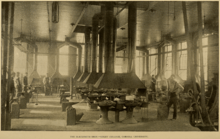
Cassier'southward Magazine, December 1891, featured an article about the Higher, including this photo from the blacksmith shop.
The higher is known for a number of firsts. In 1889, the college took over electrical technology from the Department of Physics, establishing the starting time section in the United States in this field. The college awarded the nation's first doctorates in both electrical engineering and industrial engineering. The Department of Estimator Scientific discipline, established in 1965 jointly under the Higher of Engineering and the College of Arts and Sciences, is also one of the oldest in the country.
For many years, the higher offered a five-twelvemonth undergraduate caste plan. Nevertheless, in the 1960s, the form was shortened to four years for a B.S. degree with an optional fifth year leading to a masters of technology degree. From the 1950s to the 1970s, Cornell offered a Master of Nuclear Engineering program, with graduates gaining employment in the nuclear manufacture. Still, after the 1979 blow at Three Mile Island, employment opportunities in that field dimmed and the program was dropped. Cornell continued to operate its on-campus nuclear reactor as a research facility post-obit the close of the plan. For most of Cornell'southward history, Geology was taught in the Higher of Arts and Sciences. Nevertheless, in the 1970s, the department was shifted to the applied science college and Snee Hall was built to business firm the program. Afterwards World War II, the Graduate School of Aerospace Applied science was founded as a dissever academic unit, but later merged into the engineering college.
Cornell Engineering science is domicile to many teams that compete in student pattern competitions and other engineering competitions. Presently, there are teams that compete in the Baja SAE,[two] Automotive X-Prize (see Cornell 100+ MPG Squad[3]), UNP Satellite Programme,[4] DARPA Grand Challenge, AUVSI Unmanned Aerial Systems and Underwater Vehicle Contest, Formula SAE, RoboCup, Solar Decathlon, Genetically Engineered Machines, and others.
Reputation [edit]
Cornell'southward College of Engineering is currently ranked 12th nationally by U.South. News and World Report,[5] making it ranked 1st among engineering schools/programs in the Ivy League. The engineering physics program at Cornell was ranked as being No. 1 by U.Southward. News and Globe Study in 2008. Cornell's operations research and industrial technology programme ranked fourth in nation, along with the master'due south program in financial applied science.[6] Cornell'south informatics program ranks amid the peak five in the world, and it ranks fourth in the quality of graduate didactics.[7]
The higher is a leader in nanotechnology. In a survey done by a nanotechnology magazine Cornell University was ranked as being the all-time at nanotechnology commercialization, 2nd best in terms of nanotechnology facilities, the quaternary all-time at nanotechnology research and the 10th best at nanotechnology industrial outreach.[8]
Departments and schools [edit]

With about 3,000 undergraduates and 1,300 graduate students, the college is the third-largest undergraduate college at Cornell by pupil enrollment.[1] It is divided into twelve departments and schools:[nine]
- School of Applied and Engineering Physics
- Department of Biological and Ecology Engineering
- Meinig School of Biomedical Engineering
- Smith School of Chemical and Biomolecular Engineering
- Schoolhouse of Ceremonious & Ecology Applied science
- Department of Figurer Science
- Department of Earth & Atmospheric Sciences
- Schoolhouse of Electrical and Figurer Technology
- Department of Materials Scientific discipline and Engineering
- Sibley School of Mechanical and Aerospace Technology
- School of Operations Enquiry and Information Applied science
- Section of Theoretical and Applied Mechanics
- Department of Systems Engineering
The Technology Quadrangle [edit]

Philips Hall in 2018. Much of the Engineering Quadrangle was designed in the 1950s by Perkins and Will in a similar mode to this. In the 2010s Cornell began a program to entirely renovate the Engineering Quad buildings.

Upson Hall in 2018, later on renovation.


Franklin W. Olin Jr. Hall, Chemical Engineering building (1941)
The Engineering Quad, was designed in the 1940s and 1950s on a site previously occupied past the Old Arsenal and faculty housing, using a master program developed by the Perkins and Will firm. It has undergone major changes in recent years, particularly with the completion of Duffield Hall. In 2004, relandscaping with a pattern inspired by Cascadilla Gorge was completed and its landmark sundial was restored to its rightful place on the quad (after having been stored in Upson Hall during the structure period).[x] In 2017, a $74.5 million renovation was completed for Upson Hall, completely revamping the edifice with work-friendly floors and a modernistic lounge. Also, modern and open collaborative working spaces were introduced with the construction of a large atrium connecting Duffield, which houses research and pedagogy facilities for nanoscale science and engineering, with Phillips and Upson (1956)[xi] Halls. Connected to Upson Hall, away from the quad, are Grumman Hall (1957)[12] and Frank H. T. Rhodes Hall (1990),[xiii] which currently houses the Cornell Theory Center. On the southern stop of the Quad, next to Upson Hall and almost Cascadilla Creek, are Kimball Hall, Thurston Hall[14] and Bard Hall(1963)[xv] Hall, all role of a single brick and concrete structure. Thurston is the dwelling to the Theoretical and Applied Mechanics department, and Bard Hall the abode of the Material Sciences department. Betwixt Upson and Kimball stands Ward Hall (1963),[xiv] the soon to be closed down and one-time edifice for nuclear sciences. Next to Bard, and beyond the street from the Cornell Law School, stand Snee Hall (1984)[16] and Hollister Hall (1957).[17] Carpenter Hall (1956),[18] containing the Engineering Library, stands next to Hollister on the northwestern corner. It is one of the smallest buildings on campus and the site of a protracted anti-war building occupation in 1972. The border of northern face of the quad, mostly open space, is lined with copse along Campus Road. Across Campus Route is Franklin Westward. Olin Jr. Hall (1942), dwelling of the School of Chemical and Biomolecular Engineering.[19]

Bill & Melinda Gates Hall (2014)
The virtually recently constructed engineering building is Bill and Melinda Gates Hall which opened in 2014. The building, funded in part by a $25 million souvenir from the Bill and Melinda Gates Foundation, is located beyond Campus Road from Barton Hall and east of Phillips Hall, across Hoy Road, on the site of a parking lot for Hoy Field and Grumman Squash Courts. The edifice is habitation to the Department of Estimator Scientific discipline, previously located in Upson Hall, and the Department of Information Science, formerly located off campus. The 100,000 square foot building was designed past Pritzker Prize winning architect Thom Mayne. The budgeted cost of the building was $60 million and was funded entirely from outside sources without the need for any boosted debt. Gates Hall is expected to earn at least silver LEED certification.[20] [21] Occupancy of the edifice began in early 2014 and the edifice will be dedicated in October 2014.[22]
Future developments [edit]

Weill Hall (2008), designed by Richard Meier, B.Arch. 1956.

Physical Sciences Building (2010).
The College of Engineering science has adult a facilities master plan that calls for replacements and renovations of buildings on the Engineering science Quad likewise as addressing programs housed elsewhere on the campus. Weill Hall, which opened in 2008, houses the Department of Biomedical Engineering. A new physical sciences building between Rockefeller Hall and Bakery Laboratory was completed in late 2010 and houses the School of Applied and Technology Physics as well every bit space for the Departments of Physics and Chemistry.
Design has also been initiated for a new building that will supervene upon Carpenter Hall and the north portion of Hollister Hall, providing new infinite for the Sibley School of Mechanical and Aerospace Technology and for the School of Civil and Environmental Technology.[23]
Degrees [edit]
The College of Engineering offers 14 undergraduate majors, 20 undergraduate minors, 16 MS/PhD fields, and xv Master of Engineering science fields.[24] The College of Engineering grants degrees in the following programs of study.
References [edit]
- ^ a b "Cornell Engineering: College Facts". Higher of Engineering, Cornell Academy. Retrieved July 6, 2006.
- ^ "Cornell Baja SAE".
- ^ "Cornell 100+ MPG Team".
- ^ "University Nanosat Programme". Archived from the original on June thirteen, 2008.
- ^ "Best Engineering Schools".
- ^ "Cornell Engineering Information Update". Higher of Engineering. Retrieved July 6, 2006.
- ^ "Cornell Computer science Admissions". Cornell University Information science. Archived from the original on October 29, 2007. Retrieved December 25, 2007.
- ^ "Pocket-size Times: Nanotechnology Rankings". Small Times: Mag on Nanotechnology. Retrieved July six, 2006.
- ^ "Cornell Engineering: Departments and Schools". Cornell Engineering. Retrieved July vi, 2006.
- ^ "Duffield Hall, landscaping project to give Engineering Quad new look". Cornell Chronicle. Retrieved July 6, 2006.
- ^ "2045-UPSON HALL – Facility Information". Fs.cornell.edu. Archived from the original on September 8, 2006. Retrieved November 20, 2011.
- ^ "2043-GRUMMAN HALL – Facility Data". Fs.cornell.edu. Archived from the original on September 28, 2011. Retrieved November 20, 2011.
- ^ "2051-FRANK H T RHODES HALL – Facility Information". Fs.cornell.edu. Archived from the original on September 28, 2011. Retrieved November 20, 2011.
- ^ a b "2037-KIMBALL / THURSTON COMPLEX – Facility Information". Fs.cornell.edu. Archived from the original on September 28, 2011. Retrieved November 20, 2011.
- ^ "2070-BARD HALL – Facility Information". Fs.cornell.edu. Archived from the original on September 28, 2011. Retrieved November 20, 2011.
- ^ "2049-SNEE HALL GEOLOGICAL SCIENCE – Facility Information". Fs.cornell.edu. Archived from the original on September 28, 2011. Retrieved November twenty, 2011.
- ^ "2046-HOLLISTER HALL – Facility Information". Fs.cornell.edu. Archived from the original on September 28, 2011. Retrieved November twenty, 2011.
- ^ "2042-CARPENTER HALL – Facility Information". Fs.cornell.edu. Archived from the original on September viii, 2006. Retrieved Nov 20, 2011.
- ^ "2024-OLIN HALL – Facility Information". Fs.cornell.edu. Archived from the original on September 28, 2011. Retrieved November xx, 2011.
- ^ "Home | Cornell Relate".
- ^ "Cornell University - Information Science - Gates Hall". Archived from the original on May 1, 2012.
- ^ "Dwelling house | Cornell Relate".
- ^ "Planning for the Best". Cornell Engineering Magazine. Retrieved March 28, 2008.
- ^ "Facts and Figures - Cornell College of Engineering". Archived from the original on February 5, 2011.
External links [edit]
- Official website
Coordinates: 42°26′41″N 76°29′04″W / 42.444672°N 76.484316°W / 42.444672; -76.484316
Source: https://en.wikipedia.org/wiki/Cornell_University_College_of_Engineering
0 Response to "Difference Between Cornell Engineering and Cornell Arts and Sciences"
Post a Comment